In October of 2024, the Stanford Center on Longevity (SCL) convened thought leaders for a year-long dialogue on what the next chapter of human capital investment might look like. Doers and thinkers from across higher education, the workforce system, K-12 education, philanthropy, edtech, healthcare, organized labor, and venture capital assembled multiple times to discuss, debate, and ultimately produce a vision for human-capital investment in the United States today. The 2026 report “The Future is Now” adds the employer’s perspective to this vital conversation.
IRC4HR is a proud co-founder of this valuable project.
Researchers
Mitchell Stevens

Mitchell Stevens is an organizational sociologist with longstanding interests in educational sequences, lifelong learning, alternative educational forms, and the formal organization of knowledge. As a professor with the Stanford Graduate School of Education, co-directs the Stanford Center on Longevity. He also convenes the Pathways Network (pathways.stanford.edu) and the Futures Project on Education and the Learning Society (learningsociety.io).
Anne Trumbore
Anne Trumbore leads the Sands Institute for Lifelong Learning at the University of Virginia’s Darden School of Business and served as a co-lead of the Futures Project.
Eva Sage-Gavin
Eva Sage-Gavin advised the project and championed the employer-perspective study. She has held CHRO and C-suite roles at Gap Inc., The Walt Disney Company, PepsiCo, Sun Microsystems, and Xerox, and was Senior Managing Director of Accenture’s global Talent & Organization practice. She serves on the Stanford Center on Longevity’s advisory council and is an Executive in Residence at Cornell’s ILR School, in addition to serving as a Trustee for Innovation Resource Center for Human Resources (IRC4HR).
Allison Wiley

Allison Wiley coordinated the research at Stanford.
The Stanford Center on Longevity envisions a world where everyone can thrive across a century-long life—living healthy, fulfilled, and engaged lives at every stage. Through initiatives guided by the bold framework of the New Map of Life, the Center fosters collaboration across generations, promotes equity across the lifespan, and empowers individuals and institutions alike to embrace longer lives as a powerful catalyst for social progress, economic vitality, and overall well-being.
IRC® + IRC4HR® Project Publications and Learning Materials
The Learning
Society
(website)

Project Details
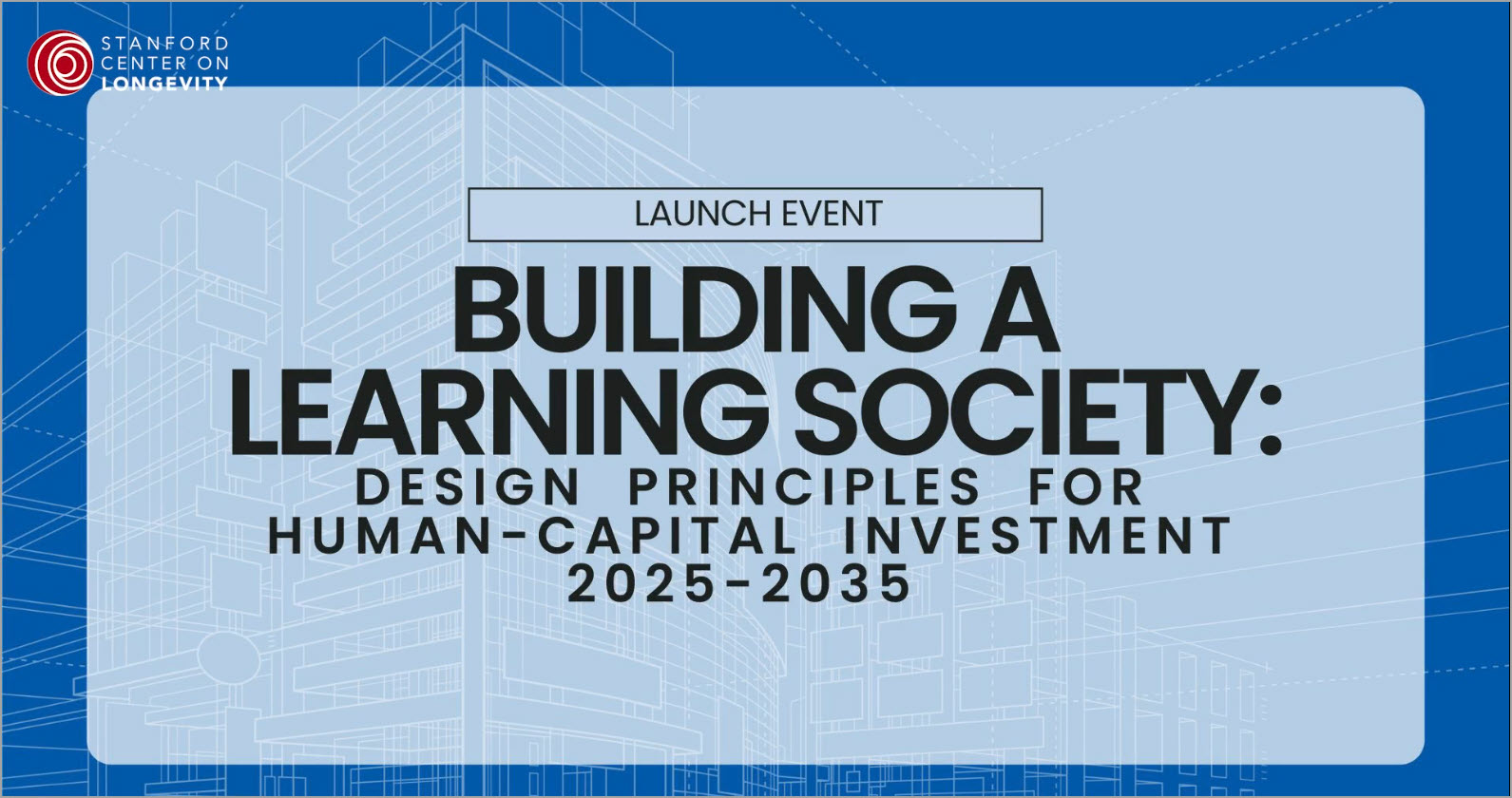
In 2024, Stanford University’s Center on Longevity and Center for Advanced Study in the Behavioral Sciences convened The Futures Project on Education and Learning for Longer Lives, a year-long effort to rethink how Americans learn across lives that now routinely span eight or nine decades. Its final report, Building a Learning Society: Design Principles for Human-Capital Investment, 2025–2035 (September 2025), launched The Learning Society, an ongoing initiative advocating a new approach to human-capital investment in the United States.
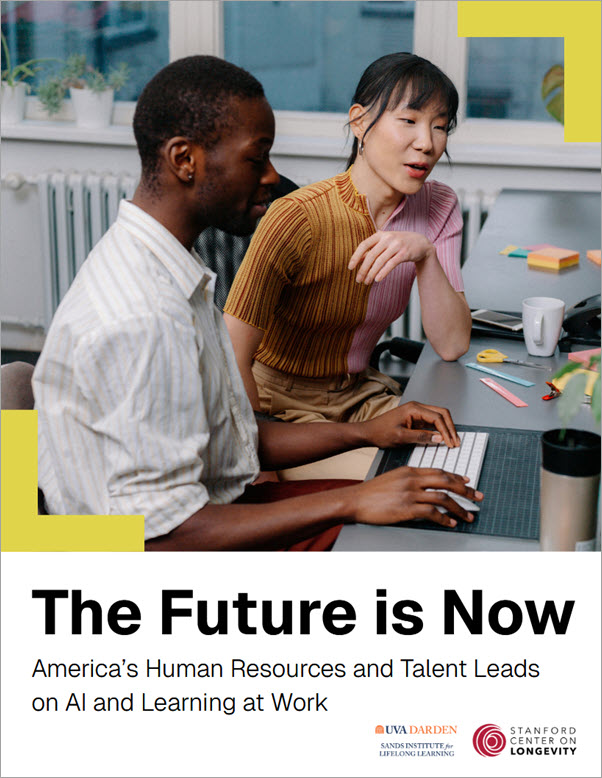
The original study drew primarily on educators, researchers, and policy experts. Eva Sage-Gavin, a project advisor and former Fortune 500 CHRO, pointed out that the employer perspective was largely missing. With IRC4HR’s support, the research team went out to obtain it. They interviewed 15 chief human resources officers, chief learning officers, and talent leads at major employers including Walmart, IBM, Accenture, Chevron, Kroger, S&P Global, Dominion Energy, and Levi Strauss & Co. The resulting report, The Future is Now: America’s Human Resources and Talent Leads on AI and Learning at Work, was published in February 2026.
The executives interviewed described a shift already underway. Companies are moving from buying talent on the outside to building it inside, treating internal development as the primary answer to skill shortages. As Prof. Mitchell Stevens notes, the findings also point to a rapidly changing relationship between technology, skills, and work. AI is transforming jobs faster than it is eliminating them, and AI literacy is becoming a baseline expectation across roles, not a specialist skill. College degrees are receding as the default hiring filter as skills-based approaches take hold.
Two findings speak directly to the Learning Society’s larger argument. According to Prof. Stevens, longer working lives make continuous learning a career-long necessity rather than a front-loaded phase, and the workplace itself is
becoming a learning institution on par with schools and universities.
