The Future of HR
Just Released!
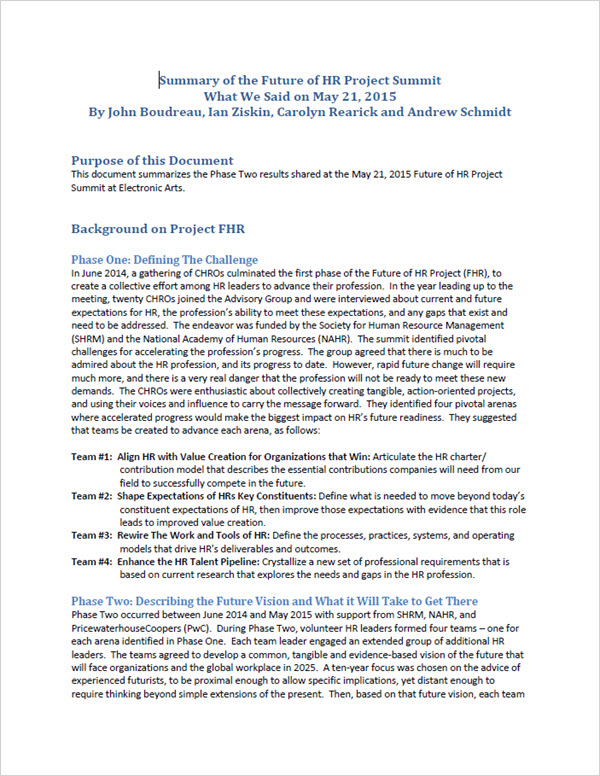
The Future of HR project (later rebranded as CHREATE) involved dozens of HR and industry leaders. Its purpose was to assess current and future expectations for HR, the profession’s ability to meet those expectations, and gaps that needed to be addressed.
The project spanned three major phases from 2013 to 2017. The various teams of the project produced interviews, tools, frameworks, predictions, examples, and dissemination materials intended to produce a movement of change in the HR profession.
More than ten years after the start of this project – and ten years since the participants published a 2015-2025 forecast – we can look back and admire their clear foresight in anticipating ways that work, workers, and HR would change over a decade. We can also appreciate the unpredictability of how change happens, and what challenges stubbornly remain. For a full evaluation of the 2015 ten-year forecast, download our retrospective report, Ten Years Later: How the 2015 Future of HR Forecasts Held Up Against 2025 Reality.
Researchers
Dr. John Boudreau

Dr. John Boudreau is recognized worldwide as one of the leading evidence-based visionaries on the future of work and organization. He is known for his breakthrough research on the bridge between work, superior human capital, leadership and sustainable competitive advantage.
His large-scale research studies and focused field research address the future of work and the global HR profession, work automation, HR measurement and analytics, decision-based HR, executive mobility, HR information systems, and organizational staffing and development.
Ian Ziskin

Ian Ziskind is a coach, consultant, author and board member. He is the former CHRO at Northrop Grumman, Qwest Communications, and TRW. Currently, Ian is President, EXec EXcel Group LLC and co-founder of Consortium for Change and Business inSITE Group.
The broader Future of Work ecosystem consisted of a core team, an advisory group, volunteers, and financial or in-kind supporters. Participants ranged from respected individual consultants to VPs and CHROs from Fortune 500 companies.
IRC® + IRC4HR® Project Publications and Learning Materials
Project Details
The Future of HR was a multi-year, multi-phase project to gather current and future expectations for HR in the face of rapidly approaching challenges, the profession’s ability to meet those expectations, and any existing gaps that needed to be addressed. It involved dozens of HR and organizational leaders from a diverse range of industries and types of organizations.
Phase One: 2013-2014
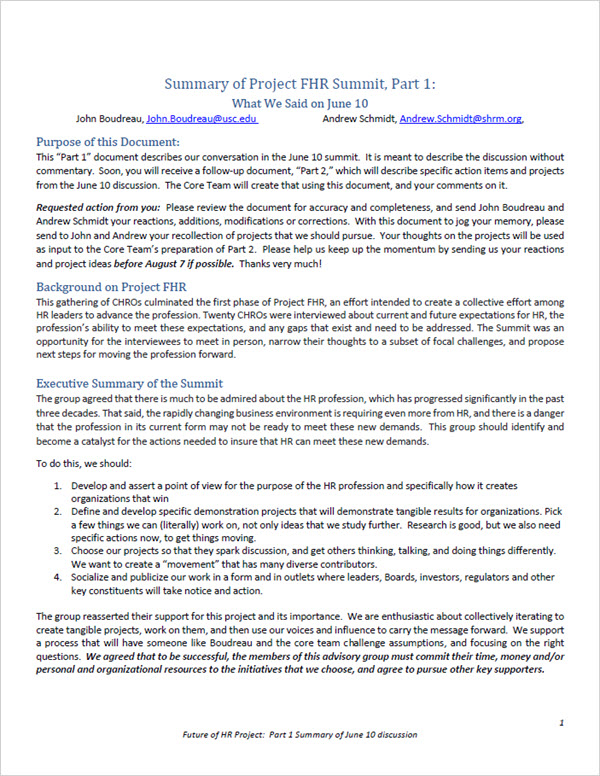
Twenty CHROs volunteered to work together to describe how the HR profession must accelerate to meet rapidly approaching future challenges. Under the guidance of the project’s Advisory Group, they were interviewed about current and future expectations for HR, the profession’s ability and challenges in meeting these expectations, and the pivotal gaps that needed to be addressed.
The phase ended with the group identifying four areas where the profession’s progress must accelerate:
- Aligning HR with value creation for organizational success.
- Shaping expectations of HR’s key constituents.
- Rewiring the work and tools of HR.
- Enhancing the HR talent pipeline.
Phase Two: 2014-2015
Volunteer teams of top HR leaders, academics, practitioners, and consultants took on each of the four areas for action identified in Phase One. to define the future of HR and work. The teams recruited thought leaders, futurists, and executives inside and outside of HR, and conducted interviews and focus groups..
They adopted a logic model: “If these trends occur, then these effects on business occur, which lead to changes in necessary organizational capabilities, which lead to changes in work, workers, and organizations, which reveal the future HR roles, operating models, and tools.”
Futurists advised that a ten-year horizon was close enough for specific implications, yet distant enough to push thinking beyond incremental extensions of the present.
The teams identified Five Forces of Change:
- Exponential pattern of technological change.
- Social and organizational reconfiguration.
- A truly connected world.
- All inclusive, more diverse talent market.
- Human and machine collaboration.
The group produced a comprehensive framework:
- Five forces of change
- Four possible future scenarios
- Five organizational capabilities
- Five new HR roles
Phase Two concluded with a Summit on May 21, 2015, where participants shared their work and presented a ten-year forecast – their predictions for HR in 2025. It was one of the most ambitious HR forecasting efforts in the profession’s history. This is the forecast our retrospective report assesses.
Phase Three: 2015-2017
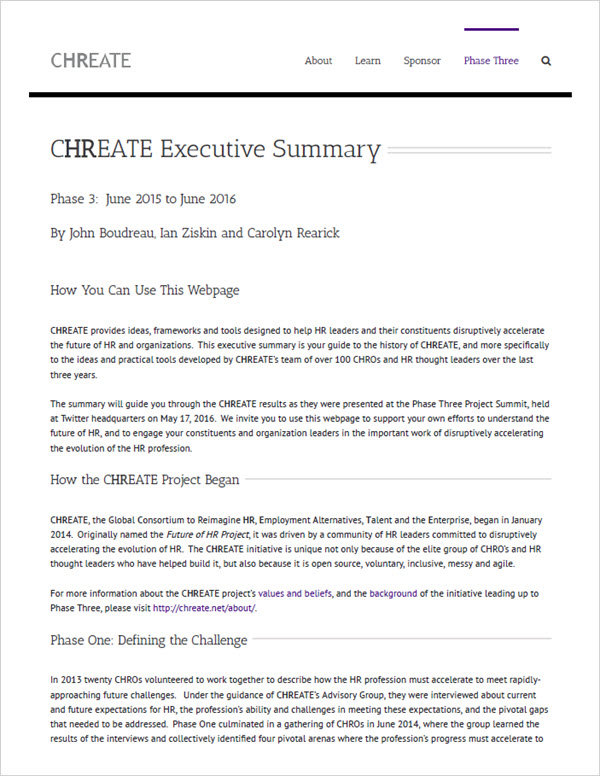
After the May 2015 Summit, the initiative was rebranded as the CHREATE project (the Global Consortium to Reimagine Work, HR, Employment Alternatives, Talent, and the Enterprise). Phase Three focused on enabling action based on the preceding phases by creating tools, examples, and dissemination materials that would help leaders bring frameworks and ideas to life in their organizations and among key influencers.
Leaders in the HR community stepped forward, forming five volunteer project teams, one for each change area from the first two phases:
- Five Forces of Change
- Four Roles Talent Pipeline
- Shape Key Constituents Expectations
- Rewire the Work and Tools of the HR Function
- Creating an Engagement Platform to Start a Movement
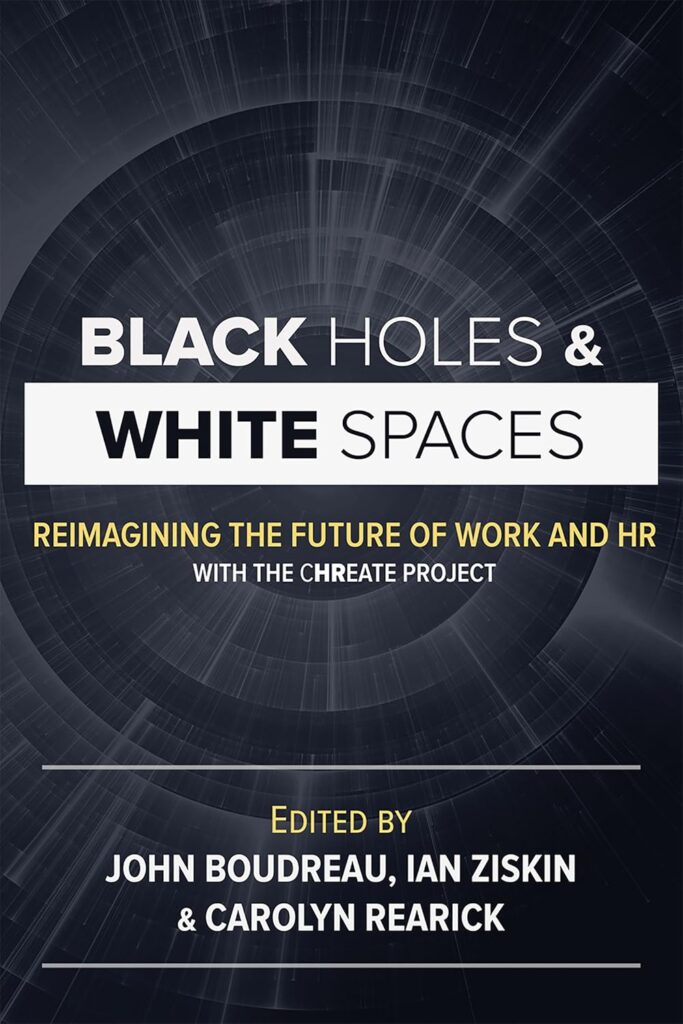
Most of the outputs of Phase Three can be found at the CHREATE.net website and in the “Black Holes & White Spaces” e-book. Some of the materials are also accessible from links in the Phase Three Executive Summary.
IRC4HR began providing financial support for the project in Phase Three. After Phase Three concluded, work continued more informally and wound down with the launch of the CHREATE.net website and the 2018 publication of the e-book “Black Holes & White Spaces: Reimagining the Future of Work and HR,” co-authored by many of the project’s participants.
A Decade Later
Ten years after the publication of the ten-year forecast in 2015, we can finally assess the accuracy of the project’s predictions. The verdict: remarkably prescient about what would change, but nobody predicted how it would happen:
- A global pandemic compressed a decade of transformation into eighteen months.
- Generative AI evolved from a research curiosity to an existential question for the profession.
- The Great Resignation forever changed the power dynamics between employers and employees.
Over the decade, CHROs became highly effective business partners for CEOs and boards of directors. Still, gaps remain:
- Only 22% of HR professionals feel their company uses HR or people analytics effectively.
- Some HR leaders still struggle with the financial and operational complexities of their expanded roles.
- Only 12% of HR leaders say they do strategic workforce planning with at least a three-year focus.
To see a detailed assessment of the ten-year predictions and some thoughts about where we go from here, please see the attached report, Ten Years Later: How the 2015 Future of HR Forecasts Held Up Against 2025 Reality.
